Monday, March 6, 2017
My Perfect Pup - Children's Book Council Notable Book
Thank you to New Frontier and to Anil Tortop for her joyful illustrations. Bring on the CBC Shortlist!
Thursday, October 20, 2016
For Keeps
Read more about this beautiful anthology Sydney Morning Herald & Kids Book Review
Thursday, May 12, 2016
Meet Scruff and Pippy - My Perfect Pups
In a way, My Perfect Pup mirrors Pippy and Scuff's own personal stories. Both of them are rescue dogs, and there are thousands of other dogs just like them who are waiting to find new homes.
We adopted Scruff from Monika's Rescue about 8 years ago, but somehow I think he was the one that did the choosing. We looked at a lot of dogs that day, but the moment we met Scruff, he worked his charms on us all...so there was no way we could leave Monika's without him.
Pippy came to us 3 years ago from another animal rescue organisation called Paws. Scruff needed a friend so we scoured the Paws website for the perfect companion. When we brought Pippy home, it took a while for the two of them to get to know each other, but now they're inseparable.
I sometimes wonder about Pippy and Scruff's previous families and how these two perfect pups ended up as rescue dogs. I'll never know the answers, but there's one thing I do know... they're both pretty happy now that they've found their perfect family.
My Perfect Pup - Release June 2016
BUY THE BOOK
Thursday, April 4, 2013
It's a new book ... take a look

I've just received copies of my latest book...and here it is! Salvetti Versus Sim published by Blake Education Australia. The story is about twelve year old James Salvetti (that's him on the cover). James is stunned when he's nominated for School Captain alongside super popular, super annoying, Harry Sim. Could James really be school captain? Not if Harry or crazy Vice Principal 'Old Mouldy' have anything to do with it.
Friday, June 15, 2012
Poetry and Music
![]() |
| Let's Sing |
Thursday, November 10, 2011
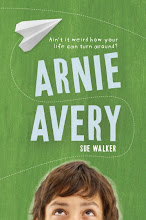
Arnie Avery is a Winner!
I am thrilled to announce that Arnie Avery is the WINNER of the 2011 Children’s Peace Literature Award.Last week I flew to Adelaide to receive the Award at a ceremony held at Parafield Gardens Primary School - a Save the Children, United Nations Global Peace School. The Year 6 children performed their soon to be recorded original songs about peace and what it means to them. It was a wonderful event - surrounded by wonderful ambassadors for peace. I was humbled and honoured to win such an important award.
Here I am with Kate Prescott, Convenor Judging Panel, Psychologists for Peace (South Australia).
Thursday, September 15, 2011
Writing Tip # 5: You have a voice!
When I open a new book, often what draws me in is the author’s style or voice. Voice is the author’s unique way of writing – it shows their personality and attitudes. If you use your own voice when you’re writing, it can make the story more interesting for the reader. Some writers experiment by using different voices for their characters. Here are a couple of my favourite examples:“Peoples are strange! The things they are doing and saying—sometimes they make no sense. Did their brains fall out of their heads?”
(The Unfinished Angel, by Sharon Creech)
“Wrestling with the straps of her survival kit backpack, which she had with her at all times, then jogging down the dry streambed toward home, Lucky thought of a question that Short Sammy's story had lodged into one of her brain crevices. She figured she had so many crevices and wrinkles, almost all of them filled with questions and anxious thoughts, that if you were to take her brain and flatten it out, it would cover a huge space, like maybe a king-size bed.
(The Higher Power of Lucky, by Susan Patron )
Pretend you are writing in your own diary. Start off with the words…
Dear Diary. This is how I make my breakfast…
Don’t be afraid to write exactly the way you speak – that’s your voice, and it can give your writing a special spark.
Thursday, August 25, 2011
Tilly Goes to China
Monday, August 1, 2011
Afternoon tea, anyone?
Each author shared their experience of writing with an enthusiastic audience of children and parents. We talked, listened, imagined, empathised...and we laughed a lot. Thank you to Trevor and Punchbowl Public for organising such a great afternoon.
Thursday, June 30, 2011
Long Live Librarians!
Thursday, June 2, 2011
More good news for Arnie!
Each year, Speech Pathology Australia awards three Australian authors the “Best Book for Language and Literacy Development” in the categories – Young Children, Lower Primary and Upper Primary. Each award is based on the book’s appeal to children, interactive quality and ability to assist speech pathologists and parents in communication and literacy development.
Sunday, May 15, 2011
Writing Tip # 4: Freewriting
Just as athletes warm-up with stretches before they exercise, I often warm-up before writing. My favourite warm-up is freewriting. But what is freewriting? Freewriting is writing without planning, and these are the rules:1. Write whatever comes into your head (no matter how strange)
2. Don’t correct your work
3. Don’t stop until your time is up.
Why not try it? Write for three minutes without stopping and you might be surprised with what you’ve written. Maybe it could be something you can use in a story.
Sunday, May 8, 2011
Arnie Avery: Crystal Kite Finalist!
Monday, April 11, 2011
Children's Book Council, Book of the Year Awards
It's incredible to see my name listed alongside some multi award-winning Australian authors...Jackie French, Garth Nix, Bob Graham...Congratulations to every Notable author and illustrator. What a fine list of books. Sunday, March 27, 2011
Books In Homes
When the teacher handed out all the new books - there was the flying shark, just like in the catalogue, all shiny and new. I'd never been so excited about a book in my life, and I read every single word. I'm sure that book turned me into a reader...and I hope that some of the students at Willmot are turned into readers after their experience today. http://www.booksinhomesaustralia.com.au/
Thursday, March 3, 2011
The Mystery of Writing
"There are two kinds of writers, those who start with a plot and those who end up with one. I am one of the latter." Elizabeth also says, "When I start a novel, I start with a feeling. It's a strong feeling, but that's all it is. There's something I very much want to say and/or understand, and I need a novel to help me do it."
Well, today I had the kind of feeling that Elizabeth refers to in her book. There is something I feel that is worthy of saying - it's hazy - but it's there, and the only way I can explain it is to put words on paper. I can almost see the outline of the character who might show me how to say what I feel. She's very hazy too, but she's lurking in a corner of my mind...perhaps waiting for her chance to 'escape into the open.'
Thursday, February 24, 2011
Marvelous Magazines
- Camels in the Outback, The School Magazine, Blast Off, Australia (Issue 2/11)
- You Light Up My Life, Comet Magazine, Pearson Education, Australia (Issue 1/11)
- Earth Hour, Comet Magazine, Pearson Education, Australia (Issue 1/11)
- Nora (short story) The School Magazine, Touchdown, Australia, Issue 1/1
- Old Sandshoe (short story) School Journal, New Zealand, Part 1/1
I was honoured to have my short story Nora illustrated by the very talented Kim Gamble - illustrator of the Tashi series.
Wednesday, February 16, 2011
Writing Tip # 3 - How to Hook Your Readers

One of the tricks writers use to hook their readers, is to write a fantastic first paragraph. The challenge is to make the paragraph so good, the reader can’t put the book down. Sometimes the author does this by introducing one or more characters and a mystery. Take a look at these great first paragraphs.
1. “Angela Throgmorton lived alone and liked it that way. One day while doing some light dusting, she heard a knock at the door.
There, on her front step, was a baby monster.”
Old Tom, by Leigh Hobbs
2. “Where’s Papa going with that axe?” said Fern to her mother as they were setting the table for breakfast.
“Out to the hoghouse,” replied Mrs Arable. “Some pigs were born last night.”
Charlotte’s Web, by E.B. White
3. “Once I was living in an orphanage in the mountains and I shouldn’t have been and I almost caused a riot.
It was because of the carrot.”
Once, by Morris Gleitzman
4. “If you are interested in stories with happy endings, you would be better off reading some other book. In this book, not only is there no happy ending, there is no happy beginning and very few happy things in the middle. This is because not very many happy things happened in the lives of the three Baudelaire youngsters.”
A Series of Unfortunate Events, by Lemony Snicket
In each of the above paragraphs we meet some characters and we’re forced to wonder – What will happen next?
1. Who is the baby monster and where did it come from?
2. What is Papa going to do with that axe?
3. Why was the character in the orphanage and how did they cause a riot with a carrot?
4. Who are the Baudelaire youngsters and why were their lives so unhappy
I know I'd want to read more to find out the answers.
Thursday, February 3, 2011
Sunday, January 23, 2011
From the Writer's Desk - Writing Tips for Kids
Tip # 1: Improve your writing with word pictures
Sometimes when we’re reading a book, it’s almost as if we’re watching a movie. The author uses words that help us to see the story. Try reading this extract from Deb Abela’s latest book Grimsden, and you’ll understand.
“Sneddon looked into a small, rounded mirror and ran his hands along either side of his hair, sweeping it upwards into a smooth, wave-like quiff.”
Did you see Sneddon fussing with his hair? Descriptions or ‘word pictures’ like this make reading fun. They help us to create pictures in our minds so that we become involved in the story.
Activity: Find an interesting picture of a person in a magazine and write a description of that person using word pictures.
Tip # 2: Taking a Look at Dialogue
What is dialogue? If you open any novel, you’ll find it. It’s the parts of the story where the characters speak to each other, and it looks like this:
“I mean it, Arnie. You need some sparring practice,” said Belly. He nodded fast. “I can teach you.”
Now it was my turn to laugh. “What? You?”
“Yeah, me. Dad used to be a boxer, you know.”
Dialogue helps to make our stories interesting, but it should give us new information and move the story forward. It should draw us in and help us get to know the characters. Here are some tips to improve your dialogue:
1. Listen to people talking. Dialogue is a cut down version of real conversation – just the interesting bits.
2. Read your dialogue out loud to see how it sounds. Would real people speak that way?
3. Try to break up your dialogue with small pieces of action to make it easier to read. Take another look at the example above – he nodded fast, and Now it was my turn to laugh are pieces of action (the characters are doing something).
4. Your dialogue should have purpose. Maybe your characters could befriend someone, reveal a secret, argue or tell a lie. It’s your job to make something happen!
Activity: Choose a partner and write a conversation between two characters. Takes turns writing a sentence of dialogue each, beginning with:
“You’ll never guess what happened.”